Showing posts with label preservation. Show all posts

Friday, April 27, 2012

Play On: The Naumburg Bandshell


If walls could talk, the Naumburg Bandshell would be New York City’s fiercest chatterbox. It’s been standing between Bethesda Terrace and Central Park’s famed, tree-lined Mall Promenade for almost 80 years, collecting memories while sharing music and words.

Visit the Bandshell early in the morning and you’ll find a brief moment of quiet and stillness.


Nauburg Bandshell Photo from Peterjr196's photostream

During the rest of the day, you’ll find actors rehearsing lines, couples posing for wedding photos, shy folks performing dreamy American Idol numbers for empty benches and, of course, every style of music. You might even find an Upper West Side old-timer recalling the bygone era when the Bandshell attracted wayward teenagers from all over the city like a magnet. All throughout the 70s, the Bandshell sheltered a burgeoning graffiti and skateboarding scene along its curved walls, shaded steps, and hidden corners. It was quite a change from the venue’s early days.

The Naumburg Bandshell was erected in 1923, but its purpose had been imagined long before then. A music-lover named Elkan Naumburg had fallen in love with classical music at the age of 15 when he could hardly afford the cost of concert tickets. Forty years later, as a successful banker, he dedicated a large portion of his hard-earned wealth to insure that New Yorkers would always have access to the city’s finest music.

Photo of Elkan Naumburg from ein Treuchtlinger in New York

Naumburg started hosting concerts in Central Park in 1905 on a wood and cast-iron pagoda-like structure that had been created by one of Central Park’s designers, Calvert Vaux. The concerts grew in popularity over the years, drawing crowds from all facets of New York society. The very wealthy would often arrive by carriage and stay there, enjoying performances from their lofty posts above those on foot. When it became more fashionable to walk to concerts, New Yorkers began mingling more freely, strolling along The Mall during performances, picnicking on the grass, and dancing after sunset.

Photo From the New York Public Library Collection

By 1912, free concerts were beginning to attract thousands of New Yorkers. Naumburg offered New York City $125,000 to build a larger, sturdier structure where operas and symphonies could be performed for the growing crowds. In 1923, a year before his death, plans for the Bandshell had been realized as a neo-classic half-dome carved out of Indiana limestone. Ten thousand people attended the dedication where Naumburg drew attention to the words he’d had inscribed on the building: “To the City of New York and its Music Lovers.”

Ever since then, music and spoken word have boomed from that the Bandshell almost without interruption. Irving Berlin, Benny Goodman, and Duke Ellington brought their performed there with their orchestras. Dr. Martin Luther King Jr., E.B. White, and Fidel Castro addressed crowds from its stage. John Lennon’s eulogy was given there, the words carrying toward nearby Bethesda Terrace and Sheep Meadow.

Despite the Bandshell’s longstanding role within New York City’s cultural life, the structure almost faced the wrecking ball in 1992. Once the neo-classical dome became a congregating spot for New York City teens and assorted ‘Parkies’ during the 1970s the location began falling into disrepair. (Check out this SHORT FILM Sunshine Rebels: Gotham's Lost Tribe, about Central Park’s most unique denizens and the Bandshell at its bohemian peak.) By the 1990s, vandals, drug dealers, and homeless New Yorkers had steadily transformed Naumburg’s gift to the city into a building that New York’s Parks and Recreation Department described as “a maintenance nightmare.”

In July of 1993, efforts to tear down the damaged and neglected Bandshell were blocked by the New York State Court of Appeals citing a city law requiring protection of municipal gifts. The building was saved but remained in a state of “demolition by neglect” until 2003 when the Central Park Conservancy and other preservation groups raised more than $2 million to see the structure restored to its former glory. Today, music plays on at the Bandshell thanks to Elkan Naumburg’s descendants and generous support from the public.


Naumburg Bandshell Photo from nycgo.com

Click here to see the complete Naumburg Bandshell schedule of Summer 2012 events.


Monday, January 2, 2012

Divine Tragedy: A Philadelphia Icon Ruined

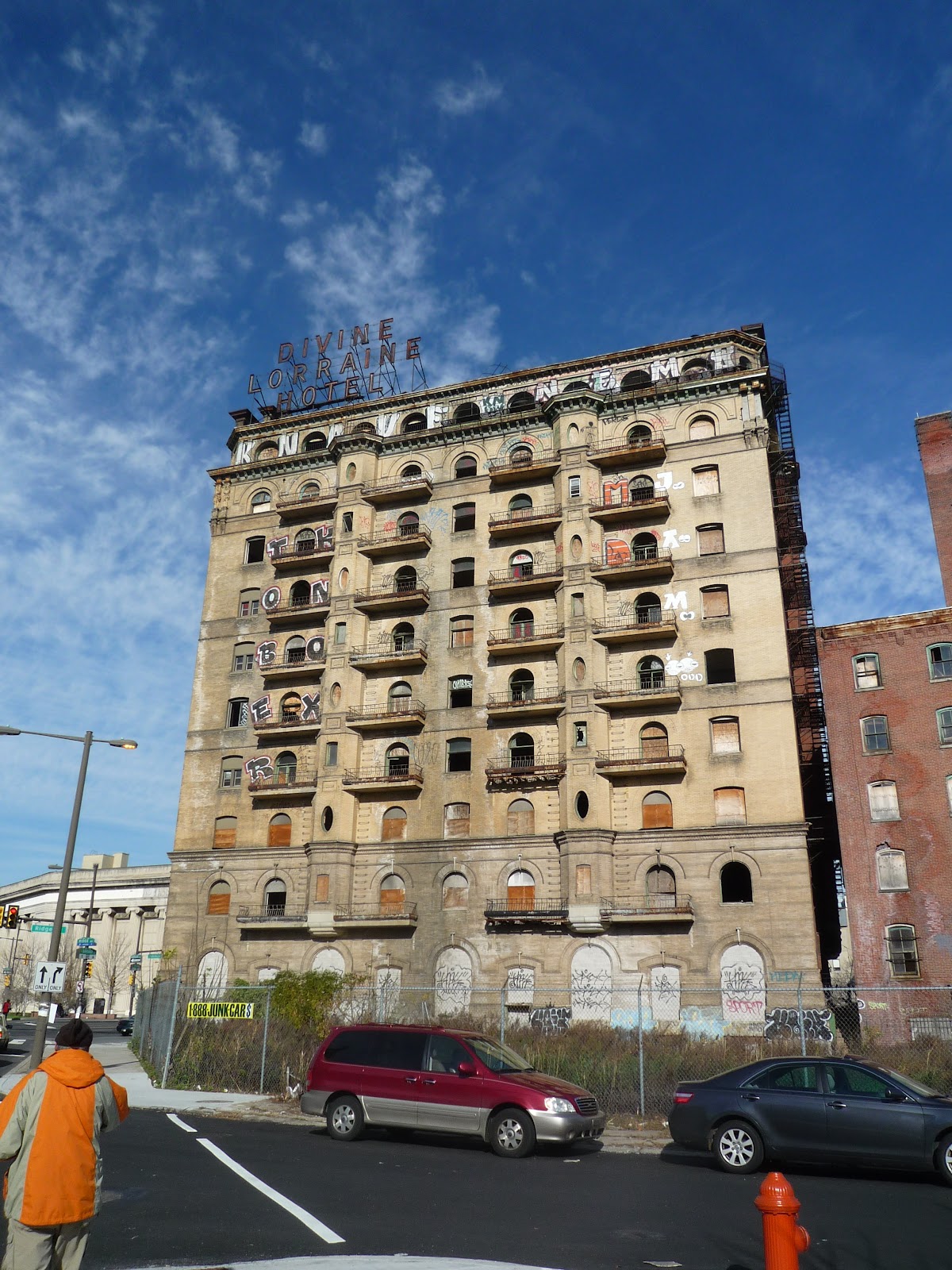
An astonishing sight looms ten-stories above North Philadelphia. The building is abandoned, broken, marred by graffitti yet majestic.

In a part of the city where dilapidated buildings are part of the urban landscape this building stands apart. It commands attention. The winds that blow through its hollows whistle the tunes a different era, hinting at stories that wait to be told.
 
Photo by Maria Gorshin 

This broke-down palace first came into being as the Lorraine Apartments in 1894, one of Philadelphia’s first high-rise luxury residences. It was designed by Willis G. Hale, a controversial figure criticized for his overly-flamboyant taste and best known as the architect of “Philadelphia’s ugliest building” - a mysterious, neglected structure that haunts Center City to this day.  The Lorraine was converted into a hotel by the Metropolitan Hotel Company in 1900, attracting wealthy clientele through 1948.

Photo by Maria Gorshin

While the Lorraine was running as a whites-only hotel in Philadelphia for five decades a cult was growing in Harlem around George Baker, the charismatic son of two former slaves. Wherever George Baker went to preach his positive thinking sermons, believers flocked and sex and money scandals followed.

Dione Wilson/FindAGrave.com
By the time he changed his name to Reverend Major Jealous Divine his preaching had developed into a belief system with a name, the International Peace Mission Movement. He had declared himself God and his notoriety had grown well beyond New York City. Songwriter Johnny Mercer attended a sermon entitled “You got to accentuate the positive and eliminate the negative” and later credited the sermon as having inspired one of his best-known songs. It was in 1948 that the Lorraine and the Divine linked. That’s when the International Peace Mission Movement bought the hotel for $485,000 – all cash donations from the Reverend’s followers.
Photo by Maria Gorshin
Reverend Major Jealous Divine quickly became a hero to black and white families in Philadelphia who struggled with poverty, racism, and drug addiction. His sermons inspired believers to find strength and his open-door policy made all feel welcome. He provided his followers with jobs, free food and affordable housing and made sure North Philadelphians always had a place to buy a cheap meal. On the hotels’ top floor, where Philadelphia high society had long gathered for social events, Divine presented free banquets. People from the surrounding community were invited into the grand lobby to buy meals for pennies.
Quebecoise/FindAGrave.com
By the time he attached his name to the roof-top sign on the building, the Divine Lorraine had become the first racially-integrated hotel in the United States. Later, as North Philadelphia shifted from prosperous to poverty-stricken, Reverend Divine’s building served as a beacon of hope in the area and his sermons began to promote equality, desegregation and anti-lynching legislation. 

So how did the Divine Lorraine fall into such tragic disrepair? By 2000, the 246-room hotel was due for extensive and cost-prohibitive repairs. It was sold to a New York developer but the building sat unused and unrestored for six years. During that time, David Peace, a member of the International Peace Mission Movement since 1953, lived in the building alone, lovingly tending to it and protecting it from the elements as best he could.
MichaelTRegan/CityPaper
The Divine Lorraine was listed on the National Registry of Historic Places in 2002. In May 2006, real estate developer Michael Treacy, Jr. purchased the building and formed a development team to oversee its use. He assured the historical integrity of the landmark would be preserved and presented plans for 135 condominiums and a restaurant. Instead the interior of the building was scavenged for everything from marble and alabaster to radiators and old mattresses. Afterward, it was left abandoned, windows shattered, the interior exposed to the elements. Today the building is undergoing a process that has been described as "demolition by neglect" - a tragic potential end for a community's icon of promise. 
Read this article in its entirety and view additional photos of the Divine Lorraine at Untapped Cities: http://bit.ly/tvVoGC


Friday, March 11, 2011

A Little Rain, Much Architecture: The Highbridge Bronx Tour


When was the last time you strolled in the rain around a Bronx neighborhood looking for architectural gems within a few blocks of Yankee Stadium? A group of 12 weather-proof preservation conference attendees did just that last weekend, basking not in the sun but in the company of likeminded "history buffs and detail geeks." William Casari, assistant professor at Hostos Community College and a Bronx resident, was accurate when he defined himself and our group as such. He led us on a tour of Highbridge in the West Bronx that offered a close look at a borough's past and present through the prism of architecture.

The tour included a stop at Macombs Dam Park, which is now the site of the new Yankee Stadium. Next, we enjoyed an informative talk about Jerome Avenue’s finest buildings then a visit to Park Plaza Apartments, a building rich with Art Deco details and Mayan motifs. A climb up Jerome Slope offered a panoramic view of Highbridge plus the opportunity to explore the area further.

Every step seemed to offer an architectural detail to capture in a photo or a nuance about life in the Bronx. A stop at a “step street” became even more interesting when a man at Diaz Superette mentioned that an out-of-control car had once launched down its full length, landing in a pile on the sidewalk below. At Noonan Plaza, a series of 7-story apartment buildings designed by Horace Ginsbern and Marvin Fine, residents carried groceries and children past a group of visitors talking about what seems like an ordinary building. In a window a little girl sat peering down at a bare quadrangle that once boasted a waterfall, a reflecting pool, swans and a Japanese-style bridge.

Several times, neighbors stopped to ask with curiosity what we were looking at then offered hospitality – by opening a locked door or by offering permission to enter a lobby. Local residents seemed unaware of the not-so-obvious treasures in their communities but Morgan Powell, a guest on the tour, is making an effort to change that: he leads walking tours in the Bronx especially designed to inform and inspire residents with updated local history.

The variety of architectural styles found on every street in Highbridge was a source of constant delight during the tour as was the element of surprise. Again and again, behind the facades of worn buildings, Mr. Casari would reveal elegant marble vestibules, Art Deco mirrors, antique signage, terrazzo floors and, in one case, the luxury of open space in a double height lobby.

Rain and high winds didn’t hamper 12 intrepid New Yorkers last week. Our enthusiasm was well-rewarded in a borough whose significance and beauty are frequently overlooked.

The following are images from that tour. Enjoy then visit hdc.org and bronxriver.org for details about upcoming tours and events.